Wednesday, February 2, 2011

Wheel dying, pt 2


Yes, I actually went through with it. And they are gorgeous! I ended up returning the poly dye after many people saying it didn't work, and bought some regular liquid RIT in Scarlet. I placed my wheels in a 8x12" pyrex, filled it up with enough boiling water to cover them, took them out, added a good splash of dye, and put them back in. They sat for about 20 minutes, flipping after 10. I kept one wheel out for comparison, and they turned out such a gorgeous shade of dark red! I'm happy ^_^

And see? Crafty AND derby!
And they have held up quite fine for the past couple of weeks, without any marks on the sport court or anything.

Also, I have a horrible desire to BUY more skates and ALL OF THE WHEELS -_-;;

Thursday, January 27, 2011

Crossovers

Totally not my picture, but gorgeous!

I hear a lot of people have trouble doing crossovers properly. The two main complaints are that they aren't achieving the proper positions, or that they have no power. Here is a wonderful video that breaks it down step by step:

http://blip.tv/file/get/BoutDerby-TechniqueWithLukeBiggerstaff292.flv
http://www.boutderby.com/forum/drills/technique-with-luke-biggerstaff

(If I was smart, I'd figure out how to embed this -_-;;)

Breaking it down, you want to make sure your stance is low, with your knees, shoulders and toes all in a vertical line. Shift your center of mass over your left skate and transfer all of your weight so that you can lift your right skate and, well, cross it over. Once your foot is down, you simultaneously push your left skate behind you as you transfer your weight to your right skate. Then, when all your weight is on your right skate and your left skate is significantly behind and to the right of your center, you lift your left skate and bring it to the front. Now you are doing the opposite, where you are pushing your right skate back while simultaneously shifting your weight to your left skate.

Yeah, I know I'm not the most eloquent person on the internet, but this should give you a basic idea. In the meantime, there are several drills you can try. You can do all of them sans skates while you build up muscle memory and confidence, and then incorporate skates as you get better.

Side stairs: Stand at the bottom of your stairwell, facing the right wall and with the stairs to your left. Take your right foot and pass it in front of you, placing it a step or two up. Use that foot to lift you up, and bring your left foot behind you to the next step (or two) up, and lift with that one. Repeat all the way up. This will help you feel the difference in push from one leg to another and will help a bit with strengthening.

Grapevines: Similar to the stairs, but on flat ground. Stand on a line, facing perpendicular to it, and pass your right foot over the left foot, making sure you are always centered over the line. Then bring your left foot behind and placing it to your side. You can continue to do this always stepping with your right foot in front, or alternating steps with your right foot in front once and then in back. When doing this with skates, try to keep your wheels straddling the line, without rolling away from it. This will help work your stability.

Drunken Sailors: Here you start on a line, facing in the same direction. Take your right foot and drop it in front of your left foot, but two feet farther to the left. Then take the left foot and drop it in front of the right foot, but two feet to the right. This is a very exaggerated motion, but again it works on throwing your weight around and switching up your balance.

As for the actual crossovers on skates, a lot of instructors will break it down into two different motions:

Skooters: Just like when you were a kid. Keep all your weight on your left foot, which is never going to be lifted off the ground, and kick back with your right foot. Make sure you glide for a bit on just your left skate so you can get used to propelling yourself with the force of your right kick. As you get more comfortable, start off the motion by placing the right foot farther in front and to your left.

The other skooter: Now try to keep all of your weight on your right skate and kick with your left skate. At first you will be pushing pretty straight, but try to push farther behind and to the right as you get more comfortable.

Crossovers (also referred to as "pushbacks"): Now that you have isolated all the parts, try to bring them together. Drag each motion out a bit at first and focus on each part. Make sure that you are pushing with both feet and shifting your weight around fluidly from one skate to the other. In the end, make sure that you are working Smart, not Hard. Make every kick count and don't skimp on the length of your strides! Oh, and don't forget to use your arms ^_^

I also just completely stole this from TinySoprano on Skatelog... but I gave a quasi-warning!

Monday, January 10, 2011

Wheel dying, pt 1.

For inspiration!

I have noticed that my posts are either very derby or very crafty, but not much in between. To remedy that, I have decided to craft up my skates ^_^ I was reading some threads over on the Skatelog Forum, and someone dyed their wheels! I think this is a wonderful thing to do, since I have pink wheels that I bought because that was the only color available, and nobody should ever have anything pink. But I might be just a bit biassed :P

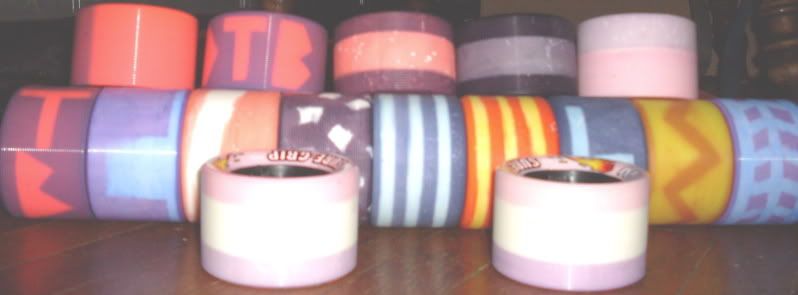
So pretty much, all they did was mix up some hot RIT dye and dunked the wheels for 10 +- 5 minutes, checking frequently, until they got the color they wanted. They even went to far as to mask off designs with painters tape or rubber cement! The one thing that surprises me, though, is that they used the vegetable (for cotton) dye on urethane, instead of the poly dye which I ended up buying. I think I might need to go extra scientific with this and get one of each and dye the wheels half and half... hmmm...

Thursday, January 6, 2011

STOP!


One of the biggest problems new skaters have is stopping (on purpose ^_^). In order to get WFTDA, you only need to do T-stops and plow stops, but sometimes something just isn't right. Here are some ideas that can help:


T-Stop:


Whatever you do, don't drag your foot behind you, perched only on the inner edge, with your skate bouncing! This is a good way to put too much resonating force on your ankle and break it, or to have someone in the pack behind you step on it, and break it!

So there are two ways to do a T-stop. The basic way is if these feet are skating up. You have your weight on the right foot, and you start digging your left foot into the ground. Ideally, you will dig with all four wheels equally. Technically, you are digging your outer wheels harder. While this is what they will actually be testing you on, it is also good to practice with these feet going left, so that you are standing on your left foot and digging your right foot -beside- you. Why this variation? So that you don't have your foot trailing behind you, again allowing for someone to step on it! As with everything, don't forget to work both with your right foot in front, and with your left foot in front. You never know what direction you are facing when you have to stop.


Plow Stop (or "how low can you go?):

I've been reading many people say that the slicker floor/wheel combination you have, the easier it is to plow stop. I can't really confirm nor deny this since I've only skated on slippy sport court with 88A's since I managed to do it right, but I can definitely vouch for spreading those legs! Then again, I am inhumanely flexible, so YMMV.

But you do want to make sure you are dropping your center of gravity by lowering your ass (not your shoulders!) and focusing on digging in your inner front wheels. As with T-Stops, make sure all eight wheels are flat on the floor so you don't flip your ankle. Once you can manage the plow, you can start transitioning to the


Hockey Stop:
This is a variation of the Plow, where you have managed to turn your body 90˚ in either direction and are placing the majority of your weight on your front foot. This video has a good idea as to how to transition from one to the other, by placing marks/sticks on the floor and trying to imitate them with your feet. Though, unlike ice, we need to stay a lot lower!


Tomahawk/Turn stop:
This is a very effective way to stop, especially if you want to pick up and go in the opposite direction! You start by skating forward, then you turn around 180˚ and dig in your toestops. The more advanced skaters can do this by jump turning, but a more deconstructed approach would be the "book"approach:

Skate forward. Lift the foot from the direction you want to turn and "open the book", placing it on the floor facing backwards. Then lift your front foot and "close the book", placing it next to the other foot, also facing backwards. Lift your ankles and dig in your toes. It is good to note that your feet don't need to end next to each other, and that staggering your stance (one foot farther forward than the other) can offer greater balance.

I don't really like this chicks videos because she talks really slow, but at least she has good form and information. Here she goes through T, Plow and Turn stops.


Wednesday, December 22, 2010

La la la, linoleum!


I skate on sport court. It is good in that it is even and has no cracks to trip on (like concrete or split wood), but it is very slippy. Yes, I am in PA. Slippy is a word. My first skates, Riedell R3, came with the Radar Caymans. 95A, viewed as a waste of plastic to most skaters I know. These were way too hard for me and I ended up getting a set of Radar Mojos, 88A, on a whim. I like them, I don't skid out, and I'm under the impression that at my now 172 lbs, I benefit from the aluminum hubs.

But I'm a compulsive shopper. I want, no, NEED new toys. I've been a good girl! Ok, but I still want new wheels. Mainly because I hate pink with a fiery passion, and that was the only color they had in stock and I really needed to get rid of the Caymans. So last night I saw some Sure Grip Blasts for sale, in red glitter :D Unfortunately, I think they are also 95A, and they looked pretty dodgy. I can't find any info on them, not even on the Sure Grip site.

I'm trying to put more research into this than I did last time. Fast Girl Skates has a wonderful compilation of articles from Blood And Thunder magazine that compiles a lot of the research I've done in one place. Though, according to this, 88A's are for beginner, shaky skaters, or should only be used as pushers, while the rest of the wheels are something harder. So I'm a fair bit better than a beginner (obviously not pro yet, though) and I don't know if I'm dragging myself down with the grippier wheels. I definitely felt like molasses the last time I skated on recently mopped concrete, but the sport court feels quite ok. Is it just that I don't know that I -could- be going faster? There are SO MANY OPTIONS!!! I'm also thinking of going the narrow (Atom Poison Slims Alloys) route so I don't trip over my own wheels. Or spinners!!!